Charging your EV from solar: how much you can actually use
Why a 7kW charger and a 4kW array rarely meet, and the three things that close the gap between generation and when the car is plugged in.
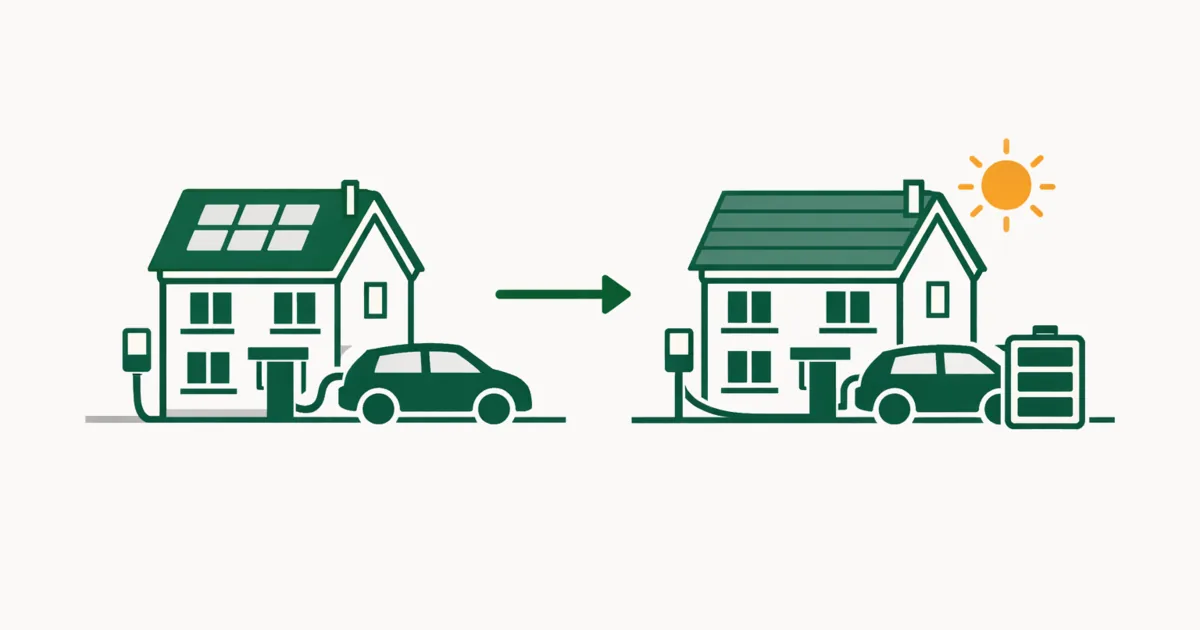
The image sold with solar and an electric car is that one charges the other. The reality is more awkward, and worth understanding before you specify either, because on some tariffs the marketing picture is not even the profitable one.
Two mismatches get in the way. A typical home charger draws more power than a typical domestic array produces, and the car is usually plugged in during the evening, when the array is producing nothing at all.
The power mismatch
A common home charger is around seven kilowatts. A common domestic array is 4kW or so, and only approaches its rated output in good conditions around the middle of the day; much of the time it is delivering a fraction of that, and the house is using some of it.
So a charger running flat out draws roughly twice what the roof can supply at its best, and the difference is imported. The panels are contributing, but they are not doing the job on their own, and on a dull day they contribute very little.
This is not a fault in either component. It is a consequence of sizing a charger for convenience, which is how they are sold.
The timing mismatch
More significant than the power gap.
Cars are generally plugged in when people get home, which is late afternoon or evening. Generation peaks around the middle of the day. The overlap between the two is small on weekdays for a household that commutes: the car spends the generating hours in a car park.
So even a large array contributes little to a car charged at 6pm, whatever it produced at 1pm. The generation happened; it was exported, at the export rate, because nothing at home wanted it.
Run the tariff numbers before chasing the dream
Here is the arithmetic that surprises people. Charging the car from your own surplus is not free: every unit you divert into the car is a unit you did not export, so its real cost is the forgone export rate, 12p on Octopus Outgoing.
Compare that with what the same unit costs from the grid overnight on an EV tariff: 8p on Intelligent Octopus Go.
On that combination, solar charging the car loses you 4p a unit: you are burning 12p export income to avoid an 8p import. The financially optimal household exports its midday surplus and charges the car at 2am, which is the exact opposite of the brochure photograph.
The picture flips on a flat tariff. Against the capped 26.11p rate with 12p export, every surplus unit into the car earns the 14p gap, and 1,000 kilowatt hours a year of daylight charging is worth about £140. So whether solar following is worth configuring depends entirely on your tariff pair, and it is a two minute comparison to run before you specify hardware for it.
Three things that close the gap
Charge during the day where you can. The simplest fix and free, when your tariff makes it worthwhile. Weekends, home working days, or anyone whose car sits on the drive during daylight. If your charger supports scheduling, set daytime windows for the days that suit.
Use solar following on the charger. Many chargers offer a mode that modulates charge rate to match surplus generation, so the car takes only what the panels are producing beyond the rest of the house’s demand. This is the feature that genuinely delivers what the marketing implies. The trade offs: the car charges more slowly, on a variable day it may stop and start, and, per the arithmetic above, on a cheap overnight tariff the mode can be configured and still not be worth using.
Add storage. A battery captures midday generation and releases it in the evening, when the car is actually plugged in. It is the most expensive answer and the one that works when the other two cannot, because it decouples when you generate from when you consume. It carries its own per cycled unit economics, and an EV tariff’s cheap window changes what the battery should charge from too.
What this means for sizing
Two practical consequences.
A larger array makes more sense with an EV, provided you can use the generation. The car adds two or three thousand kilowatt hours of annual consumption for a typical mileage, and consumption is what converts generation into savings rather than exports.
A solar following charger changes the case for a battery. If you can charge the car directly from surplus, some of the work a battery would have done is already done, more cheaply. Whether a battery still pays depends on what consumption remains outside daylight, which is the evening demand figure batteries should be sized on anyway.
The honest expectation
For a household that commutes five days a week, charges overnight and has no storage, the share of car charging that comes directly from the roof across a year is modest. Most of it comes from the grid, ideally on a cheap overnight rate at around 2p a mile, which is a perfectly good outcome and is not what the panels did.
For a household with daytime availability, a solar following charger, or storage, the share rises considerably, and on a flat tariff it is worth real money.
Both are fine. The mistake is assuming the first case will behave like the second, or paying for hardware to chase units your tariff pair prices at a loss.
Model the two together
Treating the car and the panels as separate decisions produces the wrong answer, because the interaction between them is where the value sits. Put the extra consumption and its timing into the same projection as the generation and the tariff, with the EV option switched on, and the effect shows up in the payback rather than being assumed. Then change the tariff structure in the model and watch which charging strategy wins: that single comparison settles the brochure question for your actual house.
Related
- What charging an EV at home actually costsPence per mile on each common tariff, against public rapid charging, worked from figures you can read off your own car and bill.
- Why your export rate matters less than your self-consumptionA unit you use is worth several times a unit you sell. Everything sensible about running a solar system follows from that one fact.
- Choosing a home EV chargerScheduling and solar-matching are the two features that change what you pay. The rest is styling.