How solar works
Panels, inverters and the rest of the kit, explained in terms of what each component does to the numbers on your bill.
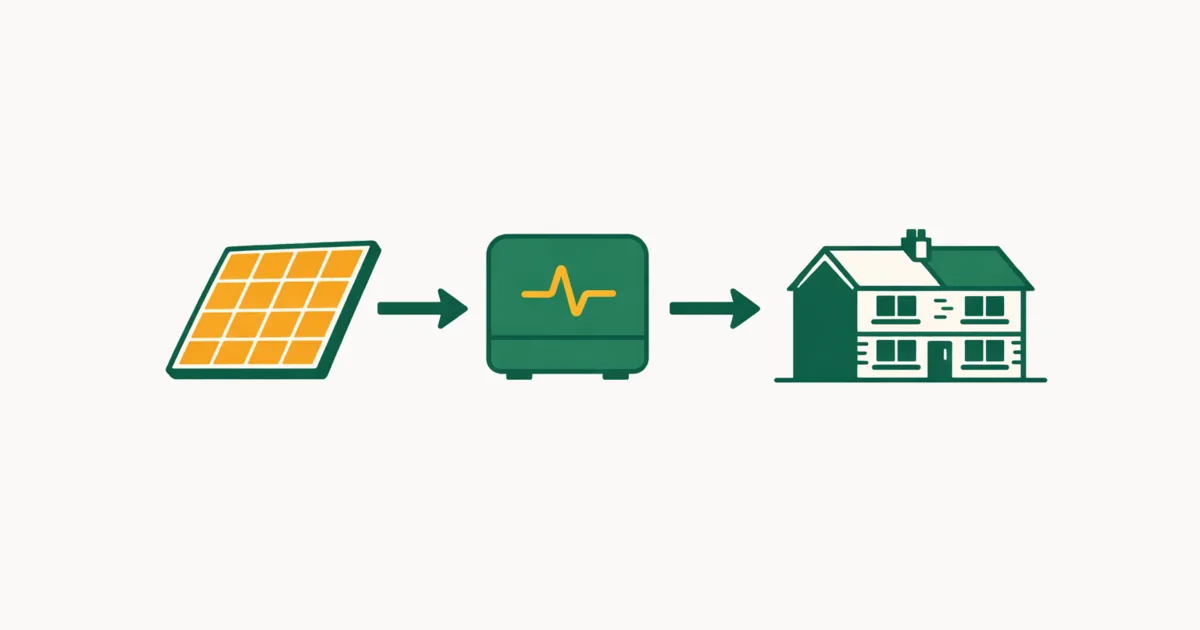
You do not need to understand semiconductor physics to buy solar sensibly. You do need to know what each component decides, because two of them materially change what the system earns and the rest mostly do not.
This hub explains the parts in terms of their effect on the result rather than their internal workings.
The panels decide the ceiling
Panels convert light into direct current electricity. Their rating in watts peak is measured under standard test conditions, which are brighter and cooler than a British roof, so the rating is a comparison figure rather than a prediction.
What actually matters for a domestic buyer:
- Total capacity, in kilowatts peak, sets the ceiling on generation.
- Physical size matters when roof area is the constraint. Higher efficiency panels let you fit more capacity into the same space, which is worth paying for only if space is what is limiting you.
- Degradation rate, the percentage of output lost per year, is normally warranted. It is small annually and meaningful across a couple of decades.
Panel brand differences get a great deal of sales attention and are rarely the thing that decides whether an installation pays.
The inverter decides what you can do
The inverter converts direct current from the panels into alternating current your house can use. It is the component most likely to fail during the system’s life, and the one whose type constrains your options later.
Three broad types:
String inverters connect a series of panels to one unit. Simple, well proven, and the usual choice. The characteristic limitation is that shading on one panel affects the string it sits in.
Micro inverters put a small inverter behind each panel, so each operates independently. This helps when shading is unavoidable or when panels sit on different roof planes at different angles. More units means more potential points of failure, though they are individually less consequential.
Hybrid inverters handle both panels and a battery. If you are likely to add storage later, specifying a hybrid at installation avoids replacing the inverter when you do.
Power optimisers are a middle path: they sit behind each panel and handle the per panel optimisation, while a single string inverter does the conversion.
The practical decision is not brand. It is whether your roof has shading that justifies per panel electronics, and whether you want the battery option kept open.
What happens to a unit of electricity
Following one unit explains the whole system:
- Light hits a panel and produces direct current.
- The inverter converts it to alternating current and loses a small percentage in doing so.
- It flows to your consumer unit and supplies whatever is switched on.
- If nothing needs it, and you have a battery with space, it charges the battery.
- If there is nowhere for it to go, it is exported to the grid and metered.
The financial consequence is entirely determined by which of steps three, four and five it reaches. Step three saves your import rate. Step five earns your export rate, which is normally much lower.
Generation meters, smart meters and monitoring
A generation meter records what the panels produce. Your smart meter records what crosses the boundary in each direction. They measure different things, and the difference between them is your self consumption.
Most modern systems come with monitoring through an app. It is worth using for the first few months, because it tells you what your actual self consumption is, which is the input every savings estimate depends on and the one that was guessed at when you were quoted.
Maintenance is small but not nil
Panels have no moving parts and generally need little. Two things are worth budgeting for:
- Cleaning, occasionally, depending on pitch, local dust and tree cover. A steep roof in a rainy climate largely cleans itself.
- Inverter replacement, at some point during the system’s life. Inverter design life is shorter than panel design life. A projection that runs for two decades and includes no inverter replacement is understating costs.
What this means when you are comparing quotes
Ask what the inverter is, whether it is battery ready, and what the conversion efficiency and warranty are. Ask whether shading on your roof justifies per panel electronics. Then stop worrying about panel brand and put your attention on the generation estimate and the tariff, which is where the money actually moves.
Everything in how solar works
- comparisonSolar roof tiles against conventional panelsBetter looking, more expensive, less efficient per square metre. When that trade is worth making.
- patternSolar diverters: turning surplus into hot waterA cheap way to raise self-consumption without a battery, and when it beats one.
- comparisonSolar hot water against solar electricityTwo different technologies sold with one word. Which one suits a British house now.
- referenceSolar panel maintenance: what it actually needsCleaning, monitoring and inverter replacement, with realistic lifetime costs and the checks worth doing yourself each year.
- conceptSolar inverters explained: string, hybrid and microWhat the inverter decides, when paying more for one changes the return, and the question that settles which type your roof needs.