Tariffs and export
What the Smart Export Guarantee pays, why export rates vary so widely, and why the tariff often matters more than the hardware.
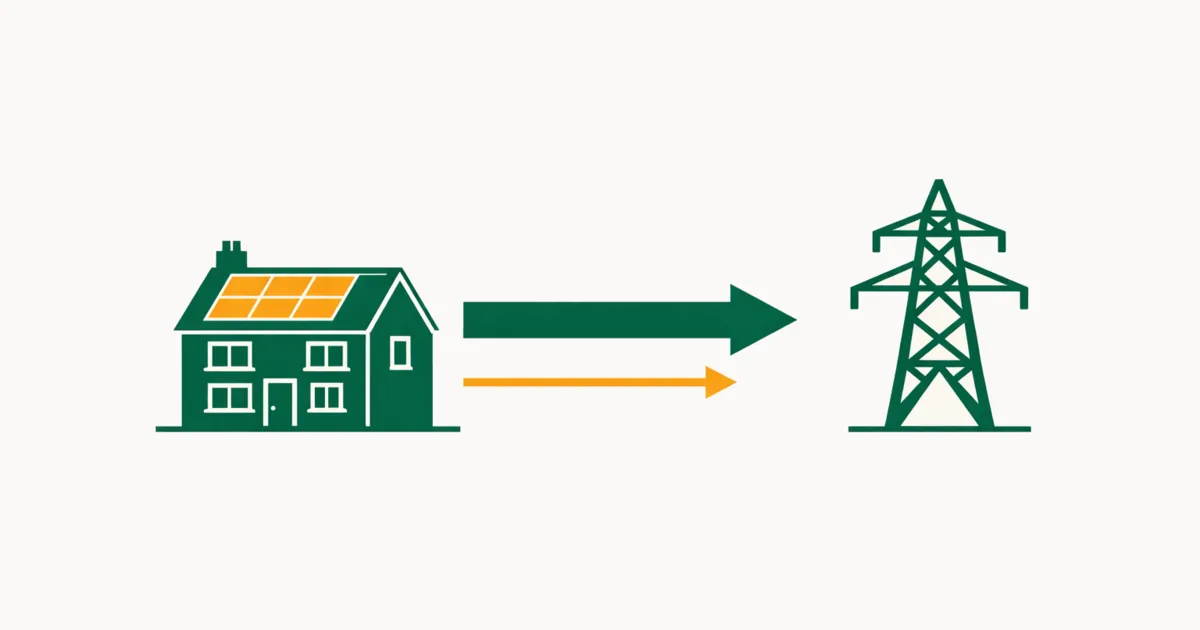
Once panels are on the roof, the thing that most changes what they earn you is not the panels. It is the pair of rates on your electricity tariff: what you pay for a unit you import, and what you are paid for a unit you export.
This hub explains how export payments work, why the rates on offer differ by more than an order of magnitude, and why the gap between your import and export rates should drive how you use the system.
What the Smart Export Guarantee is
The Smart Export Guarantee, usually shortened to SEG, is the mechanism that replaced the closed Feed in Tariff for new installations. Larger electricity suppliers are obliged to offer an export tariff, and to pay for every unit you send to the grid.
Three things follow from how it is written:
- The rate is set by the supplier, not by the government. There is a duty to offer something, not a duty to offer a particular price. This is why the spread between the worst and best offers is so wide.
- You need an export meter. In practice this means a smart meter capable of half hourly export readings.
- Your installation normally has to be certified. MCS registration, or an equivalent, is what suppliers use to establish that the system is what you say it is.
You do not have to take the export tariff from the supplier who sells you your electricity, and the best export rate is often not with the cheapest import tariff. The two can be considered separately.
Why a unit you use is worth more than a unit you export
This is the most important idea in the whole subject, and it is simple.
If you import a unit, you pay your import rate. If you avoid importing that unit because your panels produced it, you have saved the import rate. If instead you export it, you receive the export rate.
Import rates are typically several times higher than export rates. So the same kilowatt hour is worth substantially more used at home than sold. Everything sensible about running a solar system follows from that:
- Run the dishwasher, washing machine and immersion heater during daylight.
- Charge an electric car during the day where the pattern allows it.
- Add storage if the gap between your rates is wide and your daytime occupancy is low.
This is what self-consumption means, and raising it is usually the cheapest improvement available to an existing system, because it costs nothing but a change of habit.
Fixed rate against variable rate export
Export tariffs come in two broad shapes.
Fixed pays the same amount per unit whenever you export. It is predictable and easy to model.
Variable pays a rate that tracks wholesale prices, so it changes through the day and across the year. It can pay considerably more at times of high demand and very little at times of abundant generation, which in practice often means sunny summer afternoons when your panels are producing most.
Neither is universally better. A fixed rate suits a household that wants a number it can plan around. A variable rate suits one that can shift consumption and is willing to pay attention.
Import tariffs matter just as much
Because the saving from self-consumption is valued at your import rate, a household on an expensive import tariff saves more from the same panels than one on a cheap tariff. That is counter intuitive and worth sitting with: your solar system is worth more precisely because your electricity is expensive.
Time of use import tariffs, where the unit rate changes through the day, interact with solar and storage in ways that a flat rate does not. A cheap overnight window makes a battery useful even with no generation at all.
What to check on any offer
- What is the export rate, and is it fixed or variable?
- Is there a condition attached, such as having to buy your import electricity from the same supplier?
- How long is the rate guaranteed for, and what notice applies to changes?
- Does the offer require a particular meter or a particular certification?
Model both directions separately
A calculator that applies a single blended figure to your generation will get this wrong, because the two halves of the sum behave differently. The model on this site takes the import rate and the export rate as separate inputs, which is the only way the self-consumption effect shows up honestly in the result.
Everything in tariffs and export
- referenceIntelligent Octopus Go: the EV tariff that schedules your carA cheap overnight window plus supplier-controlled charging. What you give up for the rate.
- referenceOctopus Agile explainedHalf-hourly pricing that follows the wholesale market, and what that means when you also export.
- referenceOctopus Flux explained: who it actually suitsA tariff built around a battery. What the three periods do and the setup that makes it pay.
- antipatternWhy your export rate matters less than your self-consumptionA unit you use is worth several times a unit you sell. Everything sensible about running a solar system follows from that one fact.
- referenceOctopus Energy solar tariffs: what the numbers meanHow the outgoing, tracking and time of use options differ, and which generation and consumption patterns each one actually suits.
- comparisonSmart Export Guarantee rates comparedWhat suppliers pay, the conditions attached to the headline numbers, and how to work out which offer is actually best for your household.
- referenceSmart Export Guarantee explained: what you actually get paidHow the SEG works, who has to offer it, what you need in place to qualify, and why the rates on offer differ so enormously.