Do solar panels work in winter?
Yes, and much less. What the seasonal curve actually looks like and what it means for a battery.
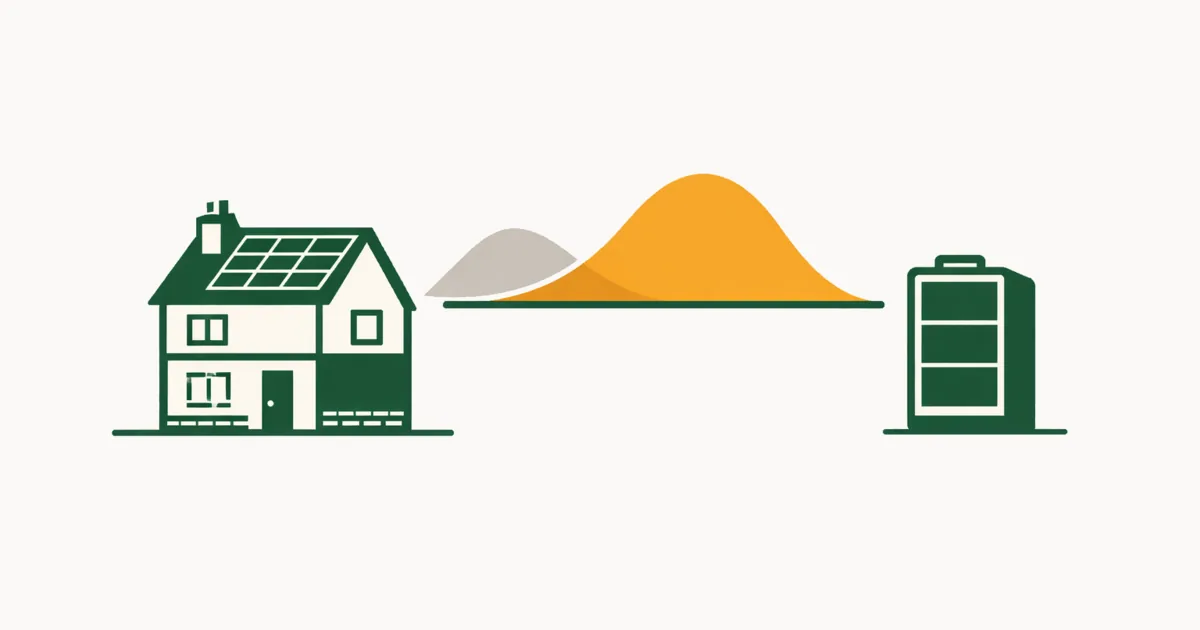
Yes, and considerably less than in summer. A British solar array produces something on almost every daylit day of the year, but the winter months deliver a small fraction of the annual total, and planning around the annual figure alone will mislead you.
The practical consequence is not that solar fails in winter. It is that a system sized and justified on annual totals can disappoint anyone who expected it to cover a December evening, and that the battery decision changes shape entirely once you look at the months instead of the year.
What actually changes
Three things reduce winter output, and only one of them is the weather.
Day length. The generating window shrinks at both ends. This is the largest effect and it is entirely predictable: London gets roughly twice as many daylight hours in June as in December before the weather says anything.
Sun angle. The sun sits lower, so light strikes a roof-mounted panel at a less favourable angle and passes through more atmosphere on the way.
Cloud. Diffuse light still generates, but less. Panels do not need direct sunshine to work; they need light.
Cold itself is not a problem. Panels are slightly more efficient when cool, which is why a bright, cold February day can produce more than a hazy warm one.
You do not have to take the shape on trust. The European Commission’s PVGIS tool produces a free month by month estimate for your postcode, orientation and pitch, and one look at its monthly bar chart for any UK location makes the rest of this page concrete: a tall summer plateau, and a midwinter trough a small fraction of its height.
Why the annual figure hides this
A quote’s annual generation estimate is correct and useless for this question. A 4kW system generating about 3,400 kilowatt hours a year, our model’s UK average, does not deliver 283 kilowatt hours every month. The total arrives unevenly, concentrated between spring and early autumn, and the deep winter months contribute a sliver each.
Meanwhile household electricity consumption usually moves the other way: higher in winter, when the lights are on longer and any electric heating is working hardest.
So generation and demand are out of phase. Summer produces a surplus you may struggle to use; winter produces a shortfall you cannot avoid importing, at the full capped rate of 26.11p per kilowatt hour. The annual saving is real; its distribution through the year is lumpy, and the lump is not in December.
What this means for a battery
This is where the seasonal shape genuinely changes a decision.
In summer, a battery has plenty of surplus to store, and its job is raising self-consumption by shifting midday generation into the evening, worth roughly 10.7p per cycled unit at current rates.
In midwinter, there may be very little surplus to store at all. On short, dull days the array may not even cover daytime consumption, let alone leave something over.
A battery is not useless in those months. Its job simply changes: it charges from the grid during a cheap overnight window, such as Intelligent Octopus Go’s 8p rate, and discharges during expensive hours. That is tariff arbitrage, it earns more per cycled unit than solar shifting does at current rates, and it works whether or not the sun appeared.
If you are buying storage partly to cover winter, make sure the system can charge from the grid, not only from the roof. Some solar-oriented setups are configured for the latter, which removes the winter case entirely, and it is a one line question to ask before signing rather than after.
What it means for expectations
Two things worth setting straight before you buy:
Your bills will not flatten. The saving is seasonal because the generation is. A large summer reduction and a modest winter one is the normal shape, and a household budgeting on the annual average will feel poor in January and rich in June.
Monitoring in January is not a fault report. Low winter output is expected. The number worth watching is this January against last January, not January against July, which is the same year on year comparison that catches real faults without false alarms.
Sizing for winter is usually the wrong instinct
You could size an array to cover winter consumption. Because winter delivers so small a share of annual output, covering a winter month means multiplying the array several times over, and for eight months of the year that oversized system would generate far beyond your consumption, selling the surplus at around 12p while you paid 26.11p for the winter evenings it still could not reach.
That is a poor trade. Sizing to your consumption and accepting the seasonal shape is almost always the better answer, with a diverter or storage to raise how much of the summer surplus you keep, and a cheap overnight window doing the winter work.
Check the shape, not just the total
When you are given a generation estimate, ask for it broken down by month rather than as one annual figure, or produce your own monthly table in PVGIS in five minutes. A competent modelling tool produces this readily, and it turns an abstract number into something you can compare against your own consumption pattern month by month.
Then put the annual figures into the ROI calculator for the payback view, knowing what the year looks like from the inside: a system that pays back in eleven years does so with ten fat months and two lean ones in each of them, and expecting that shape is the difference between a satisfied owner and a January complaint.
Related
- Home battery storage without solar: does it pay?Tariff arbitrage alone can justify a battery. When the spread between cheap and expensive rates makes the sums work, and when it does not.
- What size battery for your solar arraySize to your evening use, not to your array. A method using half hourly data, and why oversizing is the more expensive mistake.
- Do solar panels work at night?No, and the question people are really asking is about storage. What actually covers your evening.