Payback: is it worth it?
How long a system takes to pay for itself, how to work it out from your own bill, and the cases where the honest answer is no.
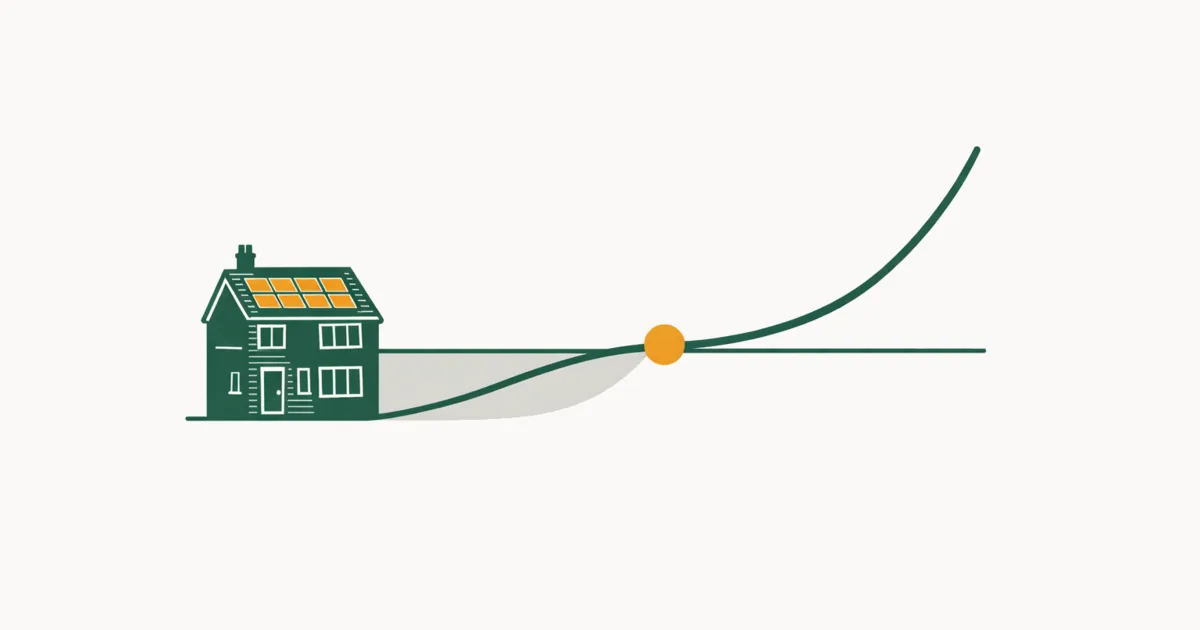
The honest answer is that it depends on four things, and you can check all four yourself in about twenty minutes. Anyone who answers the question without asking about your electricity usage, your roof orientation, your tariff and how long you intend to stay is guessing.
This hub sets out the arithmetic, the assumptions that quietly decide the result, and the situations where solar genuinely does not pay.
The four inputs that decide it
How much electricity you use, and when. This matters more than roof size. Solar generates in the middle of the day. If your house is empty then and you have no battery, most of what you generate is exported at a low rate rather than saving you the much higher import rate.
Which way the roof faces, and what shades it. South is best in the UK. East and west split the generation across the morning and afternoon, which sometimes suits a household’s usage pattern better even though the annual total is lower. North-facing is rarely worth it. A chimney, a tree or a neighbouring building can remove a surprising share of the output.
Your tariff, in both directions. The value of a generated unit is not one number. A unit you use yourself is worth the import rate you avoided. A unit you export is worth the export rate. These are usually very different, and the gap between them is where most of the disagreement between calculators lives.
How long you will stay. Payback periods for domestic solar are measured in years, not months. If you expect to move well inside that window, the question becomes what the system adds to the sale price, which is a different and much less certain calculation.
The arithmetic, in plain terms
Payback is the point where cumulative savings equal what you spent. To work out the annual saving:
- Take the system’s estimated annual generation in kilowatt hours.
- Estimate the share you will use yourself rather than export. This is your self-consumption rate.
- Multiply generation by that share, then by your import rate. That is the money you did not spend on electricity.
- Multiply the remaining generation by your export rate. That is your export income.
- Add them together.
Then divide the installed cost by the annual saving. That gives a first approximation of payback in years.
It is only an approximation, because it assumes the saving stays flat. It will not: panels degrade slowly, tariffs move, and an inverter will probably need replacing at some point in the system’s life. A model worth trusting handles all three explicitly rather than compounding a single optimistic number across twenty five years.
Where the published figures go wrong
Three patterns show up repeatedly in quotes and in marketing:
Assuming a high self-consumption rate. This is the single most influential assumption and the one most often left unstated. Moving it from a low figure to a high one can change the payback by years without changing anything physical about the installation.
Escalating savings by an assumed energy price rise. A twenty five year total produced by compounding an assumed annual increase is not a number you can spend. It is a forecast stacked on a forecast. Figures are more useful in today’s money, where they can be compared with what else you might do with the same capital.
Quoting generation rather than saving. Generation is a physical property of the roof. Saving is a property of the household. Only the second one is money.
When solar is not worth it
There are real cases where the answer is no, and they are worth stating plainly because most of the industry will not:
- A predominantly north-facing roof, or one with heavy unavoidable shading.
- A household with very low daytime occupancy, no battery, and no intention of getting one.
- A planned move well inside the payback window.
- Finance where the interest cost consumes most of the saving. A system bought with borrowed money at a high rate can have a return close to zero even though the underlying installation is sound.
None of these mean solar is a bad technology. They mean it is a poor fit for that specific house, and being told so is more useful than being sold to.
Do it with your own numbers
Every figure above is one you can find: your annual usage is on your bill, your import and export rates are on your tariff, and your roof orientation is on a map. The calculator on this site takes those inputs and shows the year by year curve rather than a single headline number, so you can see which assumption is doing the work.
Everything in payback: is it worth it?
- conceptDo solar panels work at night?No, and the question people are really asking is about storage. What actually covers your evening.
- referenceDo solar panels work on cloudy days?Diffuse light still generates. How much, and why a British climate is not the obstacle people assume.
- referenceDo solar panels work in winter?Yes, and much less. What the seasonal curve actually looks like and what it means for a battery.
- calculationHow to calculate your solar savings without a salespersonA repeatable method using your own bill and meter readings, so the number belongs to you rather than to whoever wants the sale.
- comparisonAre solar panels worth it in Scotland?Less sunlight than the south of England, but not as much less as people assume, and installation prices that are genuinely lower per kilowatt.
- calculationSolar panel payback period: how to calculate it properlyWhy the headline figure on a quote is usually optimistic, and the arithmetic that corrects it without pretending to more precision than exists.
- antipatternWhy solar panels are not worth it: five honest casesNorth roofs, empty houses, short stays, cheap tariffs and expensive finance. The situations where the sums genuinely do not work.
- patternAre solar panels worth it in the UK? Run your own numbersThe honest answer is conditional. Four inputs decide it for your home, and you can check all four from your own bill in about twenty minutes.
- conceptWhat the solar ROI calculator actually modelsA plain description of what goes into the payback figure, what it leaves out, and why a single headline number is never the whole story.