Do solar panels work on cloudy days?
Diffuse light still generates. How much, and why a British climate is not the obstacle people assume.
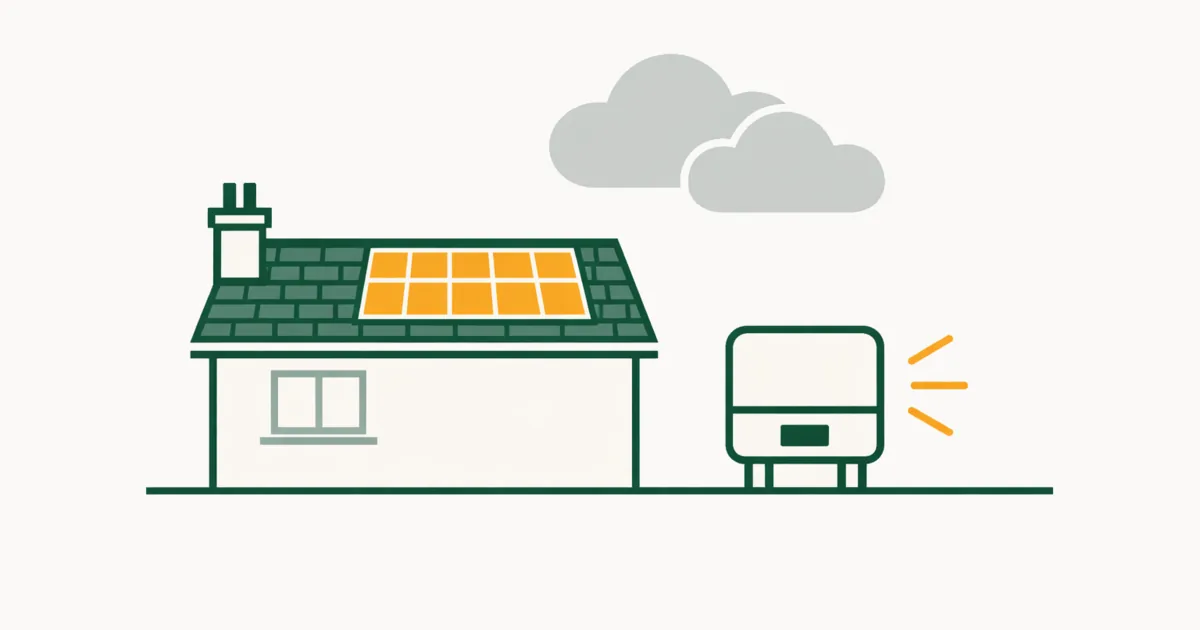
Yes. Panels respond to light, not to warmth or to direct sunshine, and an overcast British day still delivers plenty of light. Output falls, sometimes sharply, but it does not stop.
This matters because the belief that solar needs sunshine leads people in a cloudy country to dismiss it, and the arithmetic does not support that: the payback calculations on this site all run on a UK average of 850 kilowatt hours per year per kilowatt of panels, a figure that has every grey afternoon already inside it.
Direct against diffuse light
On a clear day most of the energy reaching a panel arrives as direct beam radiation, straight from the sun.
On an overcast day, that beam is scattered by cloud into diffuse radiation arriving from across the whole sky. Panels convert diffuse light perfectly well. There is simply less of it.
The practical result is that a heavily overcast day produces a fraction of a clear day’s output rather than nothing at all, and a bright but hazy day can produce a surprisingly large share. You can see the split for your own location in the European Commission’s PVGIS tool, which models direct and diffuse components separately from satellite-measured irradiance, cloud included, and it is free.
Why Britain is not the problem people think
The UK is cloudy, and it is also cool, and the second partly compensates for the first. Panels lose efficiency as they heat up, which is why their rated output is specified at a laboratory 25 degrees: a bright cool spring day in Britain can outperform a hotter one delivering the same light.
More importantly, the annual generation figures used in any competent estimate are already based on measured local irradiance data, cloud included. Certified installers are required to produce estimates using the MCS method, which works from your postcode’s irradiance zone rather than from optimism, and PVGIS does the same from satellite data. Nobody is modelling a British roof as though it sat in Spain.
So the cloud is not an unpriced risk. It is already in the number you were quoted, and if a British installation pays back in eleven years, it does so through British weather, because the estimate never assumed anything else.
What actually varies more than cloud
Three things move your annual output far more than typical cloud cover:
Orientation. Which way the roof faces, and its pitch. In our model the step from south facing to east or west costs about fifteen percent, and to due north about a third, which dwarfs the difference between an average year’s weather and a dull one.
Shading. A tree, a chimney or a neighbouring building. Unlike cloud, this is persistent, predictable and concentrated on particular panels, which is why it can be worse than weather: on a string inverter one shaded panel drags its whole string, every day, forever.
Season. Day length and sun angle change output by a large multiple across the year, the winter trough is its own subject, dwarfing the difference between a clear day and a cloudy one in the same week.
If you are worried about generation, worry about those three first. They are also the three an installer’s survey can actually measure, which cloud is not.
The consequence for self-consumption
There is a real effect worth understanding, and it is about pattern rather than total.
On a clear day, generation has a pronounced midday peak, often well above what the house is using, so a large share is exported at an export rate less than half the import rate.
On an overcast day, generation is lower but flatter, and a greater share of it is consumed directly because it sits closer to the household’s baseline demand.
So cloudy days are worse in absolute terms and can be better in terms of the proportion you use yourself. Since a self consumed unit is worth 26.11p of avoided import at the current cap against roughly 12p for an exported one, the financial gap between a clear day and a cloudy one is narrower than the generation gap suggests. The weather takes more off the kilowatt hours than it takes off the pounds.
What this means for sizing
Do not oversize an array in the hope of brute-forcing through poor weather. Cloud reduces output on the days it occurs; adding capacity raises output on every day, including the bright ones when you were already exporting surplus at the low rate. An array sized against cloud is an array oversized for every clear day it will ever see.
Size to your consumption, as the panel-count arithmetic works through. The weather is in the generation estimate; your consumption pattern is the thing the estimate cannot know.
Judging a generation estimate
When you are given an annual figure, ask which tool produced it and whether it used location-specific irradiance data. A competent estimate names its source and applies your postcode, your orientation, your pitch and your shading, and you can cross-check any figure yourself in PVGIS in five minutes.
An estimate that would be identical for a house in Aberdeen and one in Brighton has not done that, and the cloud is the least of its problems. Then put the honest figure through the ROI calculator with your own consumption and rates: the projection that results has British weather priced in from the first line, which is precisely why it can be trusted through a wet August.
Related
- Do solar panels work in winter?Yes, and much less. What the seasonal curve actually looks like and what it means for a battery.
- How many solar panels do I need?Sized from your own consumption and usable roof area, not from bedroom count or a salesperson's default.
- Do solar panels work at night?No, and the question people are really asking is about storage. What actually covers your evening.